
Wholesale Cleaning Supplies for Business: A 2026 Guide
Table of Contents
- What Are Wholesale Cleaning Supplies for Business?
- Commercial Cleaning Chemicals and Surface Cleaners
- Janitorial Tools and Equipment You Need in Bulk
- Paper Products, Disinfectants, and Sanitizers
- How to Set Up a Wholesale Account for Cleaning Products
- Best Practices for Managing Office Cleaning Inventory
- Bulk Janitorial Supplies for Small Business: What to Stock
- Sustainability and Safety Compliance in Bulk Purchasing
- Frequently Asked Questions
Last Updated: September 3, 2026
What Are Wholesale Cleaning Supplies for Business?
Wholesale cleaning supplies are commercial-grade products purchased in bulk at reduced per-unit prices, including disinfectants, janitorial tools, and paper products designed for offices, retail spaces, and service operations.
Volume purchasing unlocks distributor pricing that reflects economies of scale, freeing budget for growth while ensuring proper facility maintenance.
Wholesale suppliers offer commercial-grade formulations, case-quantity discounts, and direct-to-business shipping, delivering lower per-use costs and products engineered for commercial durability.
Commercial Cleaning Chemicals and Surface Cleaners
Commercial-grade chemicals contain higher active ingredient concentrations for heavy-duty soiling, ranging from general-purpose degreasers to specialized formulations for tile, glass, stainless steel, and concrete.
General-purpose cleaners handle 80% of typical office needs cost-effectively. Specialized cleaners address specific surfaces: degreasers for kitchens, glass cleaners for windows, and pH-balanced formulations for stone or hardwood.
Concentrated formulations extend usable life and reduce shipping costs, a gallon of concentrate yields 10-20 gallons of working solution, dramatically lowering per-application costs versus pre-mixed retail products.
Industrial-strength degreasers deliver the most dramatic wholesale savings, handling baked-on residue and high-temperature environments where standard cleaners fail.
Janitorial Tools and Equipment You Need in Bulk
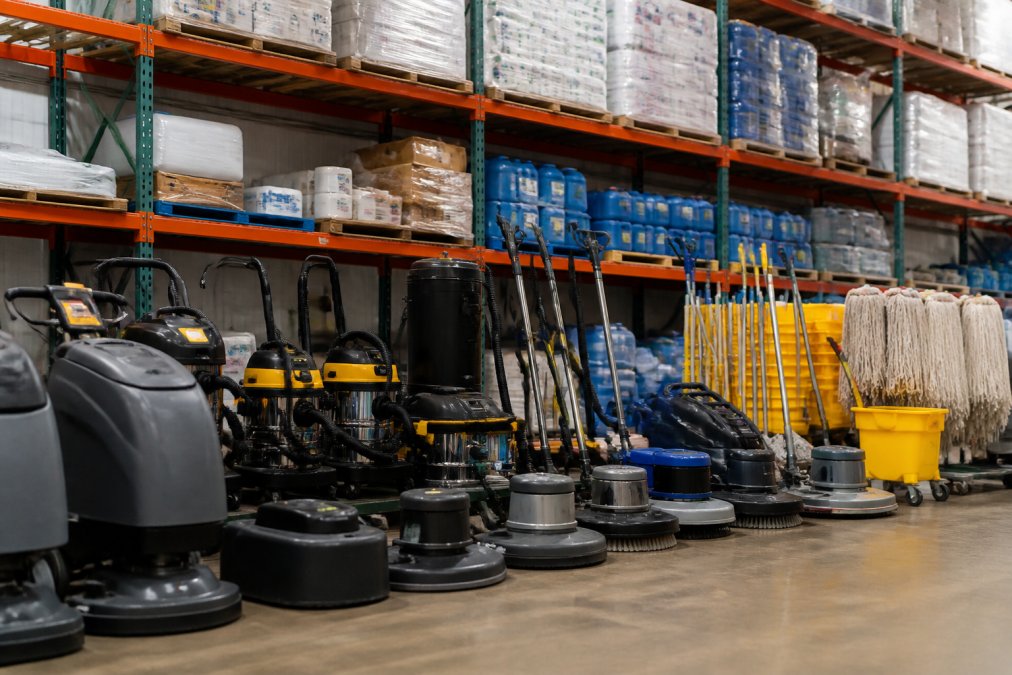
Quality janitorial tools, backpack vacuums, floor machines, microfiber mop systems, and brushes, pay for themselves through durability and consistent performance.
Commercial-grade backpack vacuums offer higher suction, larger capacity, and ergonomic designs. Commercial models handle 40+ hours weekly without degradation (the CDC).
Rotary scrubbers handle daily cleaning; burnishers maintain waxed or sealed floors. Wholesale purchasing makes acquiring both economically feasible.
Microfiber mop systems trap more dust and bacteria, require less water, and last longer than string mops. Bulk replacement pads reduce per-use costs to pennies.
Specialized brushes, grout tools, and carpet extraction equipment round out the toolkit. Wholesale suppliers bundle these items in starter kits or allow à la carte purchasing. The decision depends on your facility type, a carpeted office needs extraction equipment, while a tile-heavy retail space prioritizes grout brushes and hard-surface tools.
Paper Products, Disinfectants, and Sanitizers
Paper products are your highest-velocity consumable expense. Wholesale purchasing delivers immediate cost reduction because consumption is predictable and storage manageable.
Bulk purchasing locks in per-roll costs below retail. A facility using 50 rolls weekly realizes significant annual savings. Suppliers offer single-ply, two-ply, and premium options.
Commercial-grade disinfectants kill a broader pathogen spectrum and work faster than consumer versions. EPA-registered formulations carry documented efficacy claims, critical for healthcare, food service, and high-traffic spaces.
Wholesale advantages include reduced per-application costs and assurance of current EPA registrations and proper SDS documentation for regulatory compliance and worker safety.
Sanitizing wipes cost more per-use than sprays but enable rapid spot cleaning. Wholesale case quantities make wipe programs economically viable for high-touch surface disinfection.
How to Set Up a Wholesale Account for Cleaning Products
Wholesale account setup requires understanding distributor qualification criteria and minimum order requirements, typically tiered by order size and purchase frequency.
Applications require business documentation, tax ID, and business license. Processing takes 1-5 business days.
Minimum order quantities vary. Understanding requirements upfront prevents checkout surprises.
Payment terms vary: cash-and-carry, Net-30, or Net-60. Credit cards are standard; some distributors discount ACH or check payments.
Free shipping thresholds influence order timing. Regional distribution centers enable faster delivery. Understand your supplier's fulfillment network to prevent urgent delays.
Confirm return policies and product guarantees before bulk purchasing. Quality suppliers offer straightforward replacement for defective items and damaged shipments.
Best Practices for Managing Office Cleaning Inventory
Inventory management separates successful bulk purchasing from wasteful overstocking, maintain sufficient stock without excess that ties up capital or expires.
Document weekly usage for four weeks to establish consumption patterns. Multiply weekly usage by 8-12 to set optimal inventory levels that prevent stockouts.
Audit storage space before bulk purchasing. Supplies need dry, temperature-controlled storage away from sunlight. A 500-sq-ft office accommodates 8-10 weeks; 2,000-sq-ft handles 12-16 weeks.
Use FIFO (first-in, first-out) rotation. Label boxes with purchase dates and train staff to use older inventory first, preventing expiration waste.
Establish regular ordering patterns with suppliers. Many offer standing order programs with predetermined quantities on set dates, reducing ordering friction.
Consolidate to 1-2 primary suppliers to simplify tracking, reduce shipping costs, and negotiate volume discounts.
Bulk Janitorial Supplies for Small Business: What to Stock
Small business inventory decisions differ from enterprise facilities. Space constraints, staff size, and cleaning frequency shape bulk stocking strategy.
Essential bulk items, paper towels, toilet tissue, surface cleaner, disinfectant spray, microfiber cloths, and trash liners, cover 90% of typical cleaning needs with immediate savings.
Bulk quantity depends on cleaning frequency. Twice-weekly offices maintain 6-8 weeks of paper products and 4-6 weeks of chemicals; daily-cleaned retail spaces justify 10-12 weeks.
Specialized items depend on business type: food service needs food-contact sanitizers, healthcare requires hospital-grade disinfectants, carpeted retail needs extraction equipment.
Track monthly spending for three months. Items representing 20%+ are bulk candidates; items at 3-5% may not justify bulk buying.
| Item Category | Bulk Purchase Frequency | Typical Quantity | Storage Duration |
|---|---|---|---|
| Paper Towels | Monthly | 12-24 cases | 6-8 weeks |
| Toilet Tissue | Monthly | 8-16 cases | 6-8 weeks |
| Surface Cleaner | Quarterly | 4-8 gallons | 8-12 weeks |
| Disinfectant | Quarterly | 4-6 gallons | 8-12 weeks |
| Trash Liners | Quarterly | 8-12 boxes | 10-12 weeks |
Cleaning supplies often qualify for sales tax exemption with business tax ID, reducing costs. Confirm applicability for your business structure.
Sustainability and Safety Compliance in Bulk Purchasing
Eco-friendly cleaning products now deliver performance comparable to traditional formulations. Wholesale suppliers offer certified sustainable options across most categories.
Look for third-party certifications: Green Seal, EcoLogo, and EPA Safer Choice indicate rigorous environmental and health standards, avoiding greenwashing.
Bulk sustainable purchases reduce packaging waste. Concentrates and refillable programs eliminate single-use packaging while reducing costs.
Safety Data Sheet (SDS) compliance represents a non-negotiable regulatory requirement. Every chemical product must include an SDS documenting hazards, handling procedures, and emergency response information. OSHA mandates that employers maintain accessible SDS documentation for all chemicals on site. Wholesale suppliers must provide current SDS with every order.
Concentrated formulations require proper dilution. Create visual dilution guides and use color-coded measuring cups. Train staff on PPE for each product.
Ensure proper ventilation for bulk chemical use. Use fume hoods for concentrated products and monitor air quality in storage areas.
According to OSHA guidelines on hazard communication, employers must ensure employees understand chemical hazards through training, labeling, and accessible safety information. Bulk purchasing doesn't exempt you from these requirements, it amplifies their importance because larger quantities increase exposure potential.
Maintain a spreadsheet tracking SDS receipt dates, staff training, and safety equipment. Review quarterly to demonstrate regulatory due diligence.
Managing wholesale cleaning supplies for business requires balancing cost efficiency with operational reliability and regulatory compliance. The foundation is understanding your facility's specific needs, cleaning frequency, surface types, staff size, and regulatory environment. From that baseline, wholesale purchasing becomes a straightforward calculation: bulk quantities of essential items at reduced per-unit costs, stored strategically, rotated systematically.
BACKUPMYFILESNOW provides access to wholesale cleaning supplies through a curated marketplace offering brand-name products at wholesale prices with convenient home delivery. Our platform simplifies the procurement process, with transparent pricing, and secure checkout. Whether you're stocking your first office or managing multiple locations, BACKUPMYFILESNOW connects you to the supplies your facility needs at prices that protect your bottom line. Explore our wholesale cleaning supplies selection and discover how bulk purchasing simplifies your facility operations while reducing costs.
Frequently Asked Questions
How do I get bulk cleaning supplies for a small business?
Start by establishing a wholesale account with a supplier that serves small businesses. Many distributors offer flexible minimum order quantities and tiered pricing based on volume. Visit a supplier's website, complete their business registration form, and request a wholesale quote. Some platforms provide instant business pricing upon account creation, while others require direct contact. Once approved, you can place regular orders and often schedule recurring deliveries to manage inventory efficiently.
What are the benefits of buying janitorial supplies in bulk?
Bulk purchasing reduces per-unit costs significantly compared to retail pricing, freeing up budget for other business needs. You minimize reordering frequency and associated shipping costs, streamline procurement workflows, and ensure consistent product availability. Bulk buying also allows you to lock in pricing and negotiate volume discounts with suppliers. For businesses managing multiple locations or high-traffic facilities, bulk orders reduce storage space demands over time and provide cost predictability for budgeting.
What essential cleaning products should every business stock in bulk?
Stock commercial-grade disinfectants, surface cleaners, and degreasers for daily sanitation. Include paper towels, toilet tissue, and trash liners as high-volume consumables. Add floor care products like strippers and waxes, sanitizing wipes, and all-purpose cleaners. For specialized needs, consider specialty chemicals for restrooms or break rooms. Janitorial tools including mops, brooms, brushes, and microfiber cloths are essential. Prioritize products based on your facility type and foot traffic; offices need different supplies than food service or healthcare environments.
How can businesses qualify for wholesale cleaning supply pricing?
Most wholesale suppliers require business registration and verification. You'll typically need a business license, tax ID, or proof of business entity. Some platforms offer instant qualification through online registration, while others conduct manual review. Minimum order quantities vary by supplier, many accommodate small businesses with reasonable thresholds. Pricing tiers often depend on order volume and frequency. Contact suppliers directly to confirm eligibility requirements and discuss your specific business needs to access their best wholesale rates.
This article was written using GrandRanker